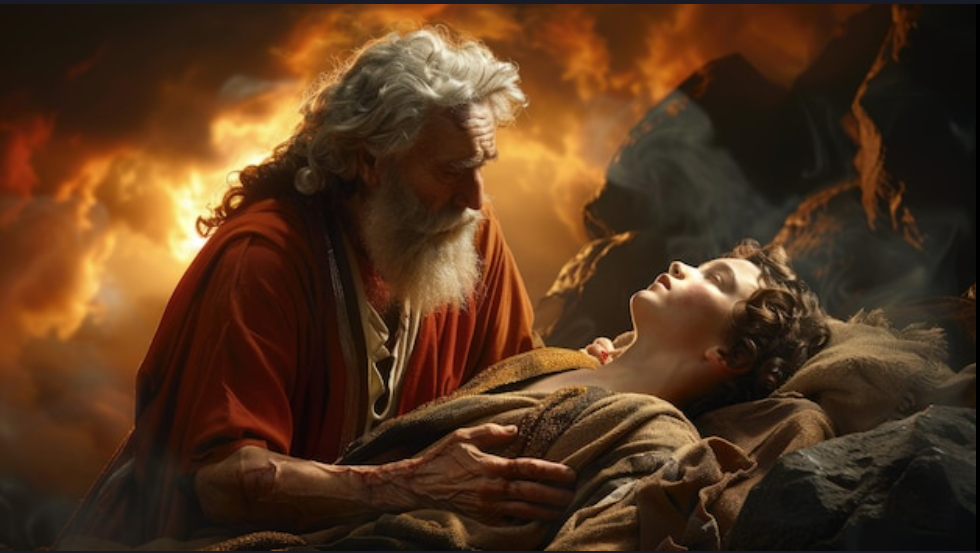
BY RON BARTANEN ─ A major climactic event in Abraham’s life surely is evident in the reading of Genesis 22:1-18. While many events in the life of this patriarch reveal his deep faith in God, a faith totally submissive to God’s word, this one stands at the top of the list. “After these things’ (v. 1) references such things in context as the birth of his son, Isaac and his establishment as the heir to God’s promises. How long is not stated, but it was obviously some years afterward. The historian Josephus declared Isaac to have been twenty-five.
This verse also declares that in speaking to him God “tempted” him, testing his faith. While God’s motive was not to entice him to sin, which the Bible asserts is contrary to the holy nature of God (James 1:13), but rather to test the genuineness of his faith. The American Standard Version translation of the word is to “prove”, an appeal to do the right thing, and not to be hindered by the painfulness of his decision. I believe God’s purpose was twofold: to both test and strengthen his faith. James 1:13 asserts that the trying of one’s faith works patience, eventual steadfastness. If one yields to God in obedience, his faith is strengthened. If one fails the test, one should learn to exercise more dependence on God for strength.
The test was clear and heart-rending: he was commanded to take his son—his only son, whom he loves –and offer him to God as a sin-offering. Abraham is torn by a conflict of fatherly love versus obedience to God. He chose obedience. Hebrews, chapter 11, clarifies the thoughts he had, believing that God would raise Isaac from the dead (vv. 17-19).
The trying of his faith was amplified by his three-day journey to the mount in Jerusalem to God’s chosen location for the sacrifice (vv. 3-5). The three days could be seen as prophetic of Jesus’ three years journey of his ministry up to His site of crucifixion in Jerusalem, now known as Calvary, a place chosen by God—where, in figure, Isaac had shed his blood.
Abraham had believed God for Isaac’s miraculous birth, and he now believed God for Isaac’s deliverance from death. Hebrews 11:17-19 speaks of Abraham’s faith being even in his “only begotten son’s” resurrection from the dead. In writing of this, Moses even mentions that the wood for the burnt offering was laid upon his son, a type of Christ’s bearing of His wooden cross, and with it, the sins of mankind. (cf. vv. 6-10).
Isaac’s life was spared, but, as Abraham declared, “God will provide himself a lamb for a burnt offering” (v. 8), also described as a ram, caught by its horns in a thorn bush, a fore-type of Jesus, our sacrificial Lamb of God, crowned with a crown of thorns at His death, paying the price for our sins (John 3:16; John 1:29; Rev. 5:6).
There is no indication of the youthful Isaac struggling against his aging father to avoid being sacrificed on the altar. He would be a submissive sacrifice, a type of Christ, who was “led as a sheep to the slaughter” (Acts 8:32).
Jesus could have left us burdened with sin, but chose to take the load upon Himself. The apostle Paul wrote of the gospel (good news), saying that “Christ died for our sins according to the scriptures: and that he was buried and that he rose again the third day according to the scriptures” (1 Corinthians 15:3-4), and we identify with Him in dying to sin in repentance, and being” buried with him by baptism into death, that like as Christ was raised up from the dead by the glory of the Father, even so we should walk in newness of life” (Romans 6:4).
Have you thus accepted Christ as your Lord and Redeemer?

- Questions about Heaven and Hell: Fulford - 2026-05-19
- Us and them - 2026-04-11
- Christ in Genesis: The offering of Isaac - 2026-03-08