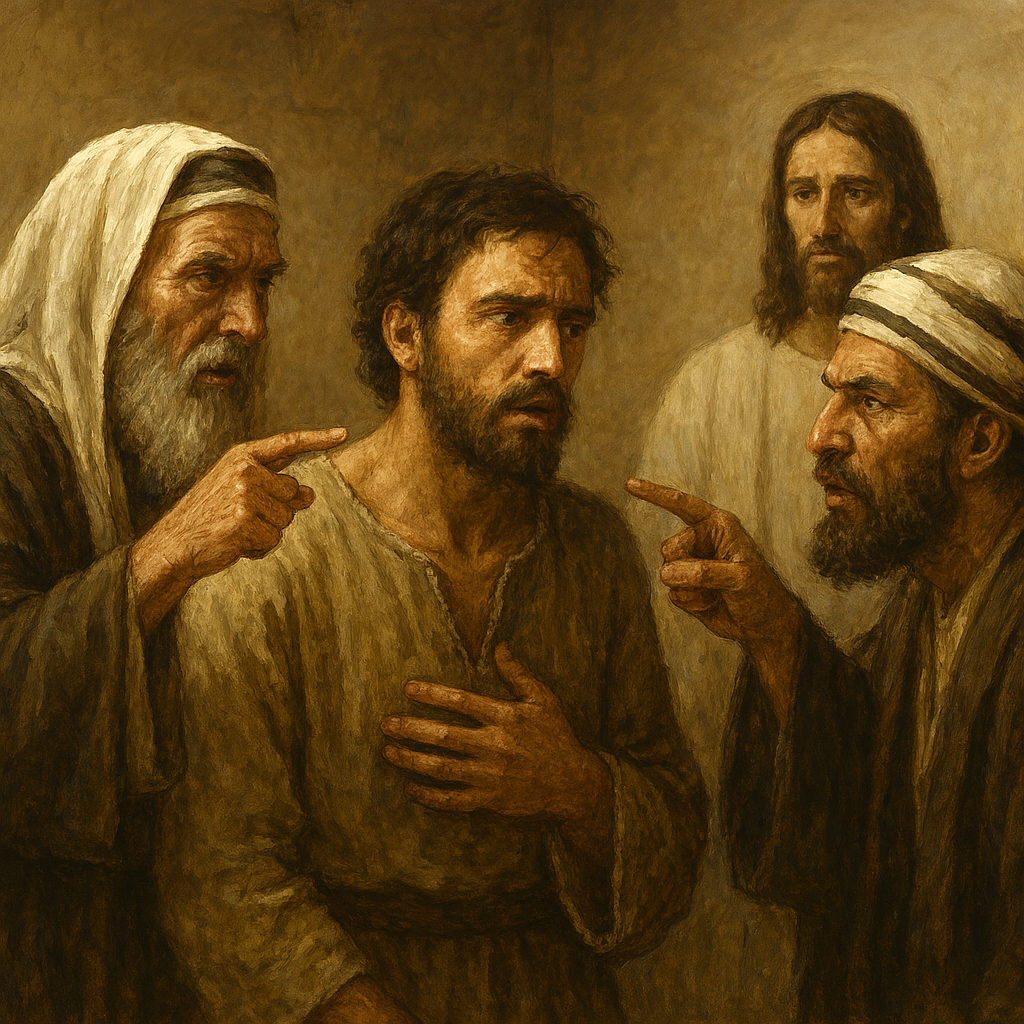
“They brought to the Pharisees the man who had been blind. Now the day on which Jesus had made the mud and opened the man’s eyes was a Sabbath. Therefore the Pharisees also asked him how he had received his sight. ‘He put mud on my eyes,’ the man replied, ‘and I washed, and now I see.’ Some of the Pharisees said, ‘This man is not from God, for he does not keep the Sabbath.’ But others asked, ‘How can a sinner perform such signs?’ So they were divided.” (John 9:13-16 NIV)
I’m sure we’ve all met Christians who want to examine everything someone says or does. Perhaps they think they know the Bible well enough to sit in judgment on others or perhaps they are just suspicious of everyone, especially someone who says or does something that is different from what they think. The Pharisees in Jesus’ day seem to be in this category.
Jesus had healed a blind man in Jerusalem. He had healed other blind people, but this man had been born blind – he had never been able to see. Even today this is not something for which we have found a cure. Those who knew the man found it difficult to believe that he was now healed. Such things didn’t happen! They took him to the religious leaders, the Pharisees. This group were regarded by the Jews as being the most religious because of their knowledge of the scriptures.
Although it was obvious that an extraordinary miracle had been done by Jesus, because he healed the man on the Sabbath the Pharisees automatically condemned him and what he had done – he couldn’t be from God because, in their eyes, he didn’t keep the Sabbath. Those who heard them could see a problem in this answer: the fact that he had healed the man showed that he had to be from God.
The Pharisees were so concerned that the Jews would faithfully keep God’s law that, over the years, they had come up with clarifications to ensure that everyone knew what they could and couldn’t do the Sabbath. When God gave the Ten Commandments he had included provisions for the Sabbath.
“Remember the Sabbath day by keeping it holy. Six days you shall labour and do all your work, but the seventh day is a sabbath to the Lord your God. On it you shall not do any work, neither you, nor your son or daughter, nor your male or female servant, nor your animals, nor any foreigner residing in your towns. For in six days the Lord made the heavens and the earth, the sea, and all that is in them, but he rested on the seventh day. Therefore the Lord blessed the Sabbath day and made it holy.” (Exodus 20:8-11)
The Sabbath was to be a day of rest when no work was to be done. But what exactly was work? Through the years the Pharisees came up with a long list of what they classified as work and what wasn’t work. Although they made exclusions for doing good – necessary things like feeding, watering, and taking care of their animals – but they had no provisions for healing someone, as this wasn’t something that normally was done. So when Jesus healed someone on the Sabbath they would immediately condemn what he had done as ‘work’. Their problem, as Jesus pointed out, was that they were spiritually blind.
“Jesus said, ‘For judgment I have come into this world, so that the blind will see and those who see will become blind.’Some Pharisees who were with him heard him say this and asked, ‘What? Are we blind too?’ Jesus said, ‘If you were blind, you would not be guilty of sin; but now that you claim you can see, your guilt remains.’” (John 9:39-41)
It is sad when we blind ourselves because we have added to God’s word. May we learn to not embellish what Jesus had revealed to us but simply obey it and live by it.
Image created by Apple’s Image Playground by Jon Galloway.
Readings for next week: John 7-11
- Blinded by their own interpretation - 2026-05-15
- Believing in Jesus the Messiah - 2026-05-08
- Avoid godless, foolish arguments - 2026-05-01