“As Jesus was leaving the temple, one of his disciples said to him, ‘Look, Teacher! What massive stones! What magnificent buildings!’” (Mark 13:1 NIV)
Jesus and the apostles left the temple, walked through the Kidron Valley and up onto the Mount of Olives (Matthew 24 gives more detail of where they were). As they were leaving the temple one of the disciples pointed out the structure of the temple itself. It was magnificent! Josephus, the Jewish historian, said that it was “immensely opulent” and compared it to a beautiful snowcapped mountain. He recorded that these stones were white limestone, some measuring 70 feet long x 12 feet high x 18 feet broad.
The temple at this time was still going through a period of refurbishment, initiated by Herod the Great, and wasn’t completed until 64 AD. The temple complex itself was immense, being twice the size of the Acropolis in Athens and filled one-sixth of the entire city of Jerusalem – the temple dominated the city.
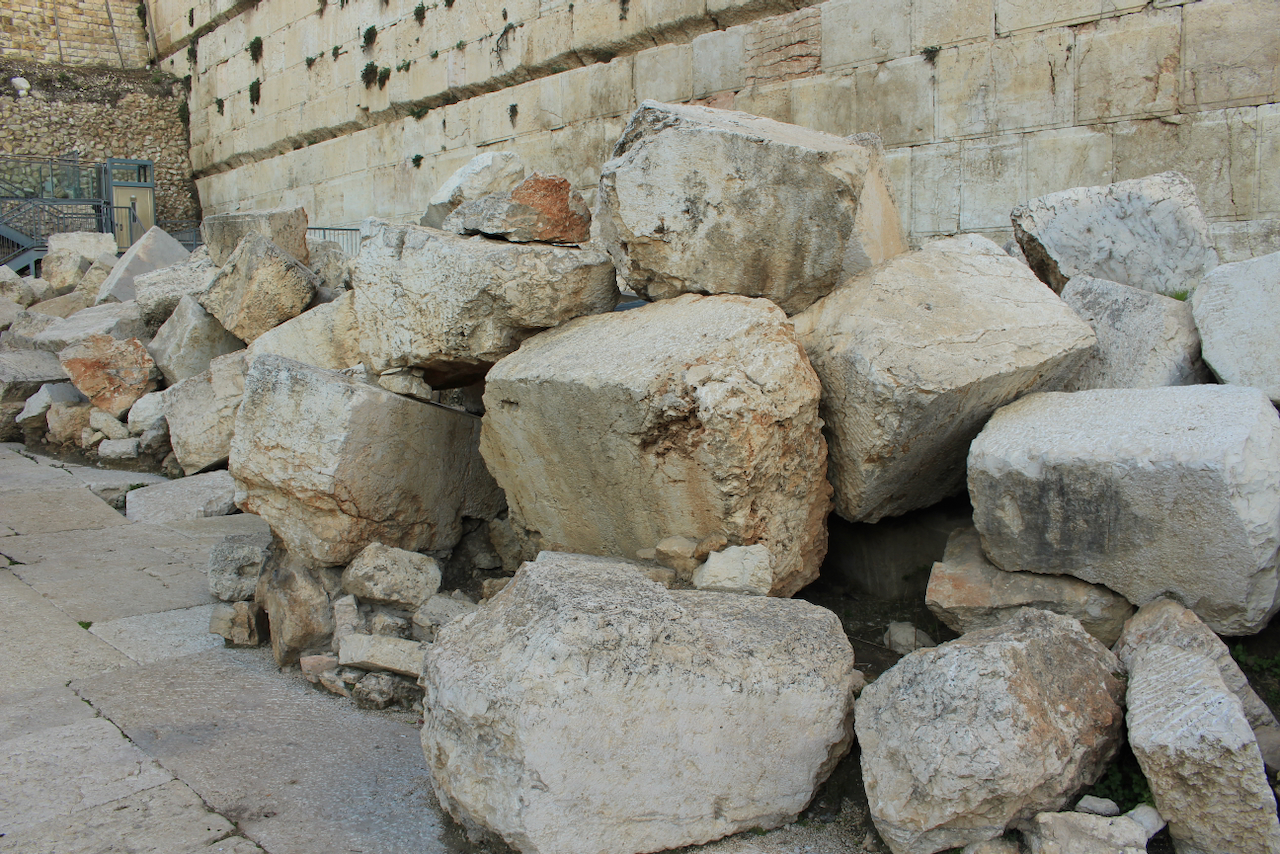
The disciple pointed out the size of the massive stones that could be seen. When visiting Jerusalem today you can take a tour below the Western Wall along the foundation of the temple and you can see how immense these stones were! Can you imagine the surprise the apostles received at Jesus’ next statement?
“‘Do you see all these great buildings?’ replied Jesus. ‘Not one stone here will be left on another; every one will be thrown down.’ As Jesus was sitting on the Mount of Olives opposite the temple, Peter, James, John and Andrew asked him privately, ‘Tell us, when will these things happen? And what will be the sign that they are all about to be fulfilled?’” (Mark 13:2-4)
Despite the size of the stones and the magnificent structure, it would not last. It would be destroyed with “not one stone…left on another”. At the foot of the temple wall in the Jerusalem Archaeological Park there is pile of these stones that are from the temple, showing that what Jesus said was true. How did they get there? The historical records tell us that the Roman army used fire to blast the stones off the temple mount.
Jesus’ followers were obviously shocked at such a statement and wanted to know more, especially when this would happen and whether there would be any warning. Jesus told them that it would happen when an army invaded Jerusalem and the temple would be destroyed (the rest of Mark 13 and Matthew 24 give more details about the coming destruction of the city).
The problem with buildings is that they won’t last forever. Travelling throughout Scotland, where I live, you can see where houses used to be and even where villages used to be, but sadly the buildings are only shells or just foundations. There are even Roman ruins in the UK but all you see are the foundations – what you are visiting are ruins which give us an indication of what the place was like.
Buildings don’t last but we have a temple that will last forever. God’s temple today isn’t a building but his people. It is you and me. Paul wrote about this to the Christians in Corinth, showing this temple is God’s people collectively (1 Corinthians 3:16-17) and each Christian individually (1 Corinthians 6:19-20).
There are great implications that this has for us. We are God’s temple because we have his Spirit living in us. This makes us a ‘holy people’. If we have his Spirit is in us then we need to be careful in how we live. In reality, our body is not our own – we belong to God. Because he bought us with a price we need to glorify God in our body. We need to realise who we are because of the price paid for us.
“But you are a chosen people, a royal priesthood, a holy nation, God’s special possession, that you may declare the praises of him who called you out of darkness into his wonderful light.” (1 Peter 2:9).
Pile of stones from the Temple, Jerusalem Archaeological Park, Israel, by Jon Galloway.
Readings for next week: Mark 10-14
- Faithfulness to the good news of Jesus - 2026-06-12
- The need to fight for what we believe - 2026-06-05
- The tomb was empty! - 2026-05-30